

Models & Pricing
A model record is what clients send as model — a name you choose, mapped to one or more providers with capability flags, context size, and prices.
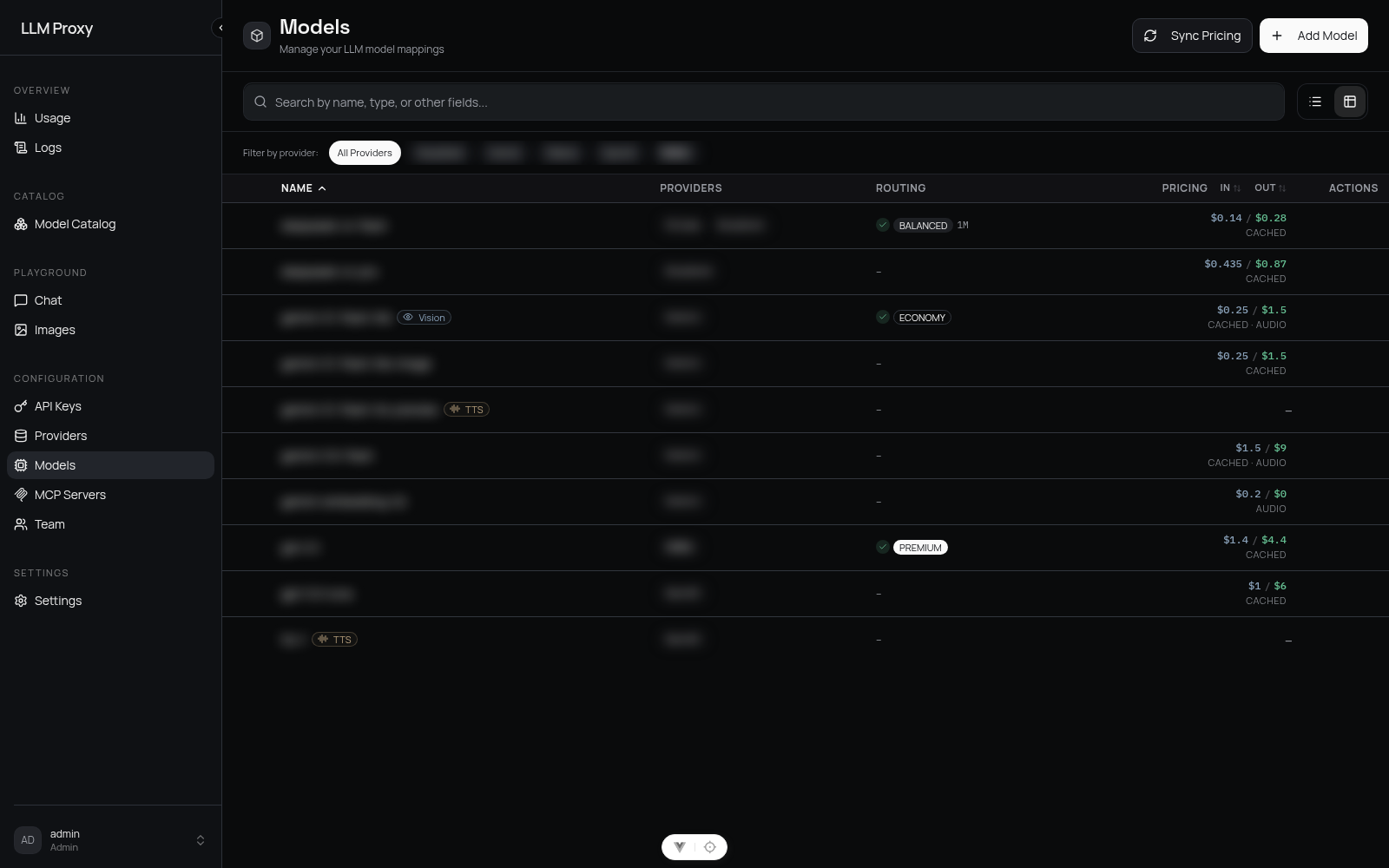
Anatomy of a model record
| Part | Purpose |
|---|---|
| Name | The client-facing alias (e.g. gpt-5.6-luna). Unique. Exact match only — no wildcards |
| Provider mappings | One entry per provider that can serve it: provider_name, upstream provider_model_name, and priority |
| Capability flags | supports_images (vision), supports_image_generation, supports_tts, supports_stt, supports_embedding, supports_realtime, supports_systemone (decision models) |
| Catalog metadata | context_length, max_output_tokens, family, release date, knowledge cut-off, and models.dev attributes (attachment, reasoning, tool_call, structured_output, temperature, open_weights, status) |
| Pricing | Model-level rates, optionally overridden per mapping (see below) |
| Parameter overrides | Extra parameters injected by provider config → model → mapping (most specific wins) |
| Retry/timeout | max_retries overrides the global default for this model |
| Smart routing fields | auto_eligible, quality_tier (economy/balanced/premium), routing_assignments, used only when smart routing is on |
Not every flag is enforced everywhere: supports_images and context_length filter smart-routing candidates, supports_realtime is enforced on the Realtime WebSocket, and supports_systemone marks a decision model — it gates both evaluation endpoints, /v1/systemone and /v1/decisions; the remaining flags are catalog/display metadata.
Provider priority and fallback
- Selection uses the mapping's
priority(higher wins) — the provider's ownpriorityfield is not consulted. - Candidates are grouped by mapping priority; the highest non-empty group is tried first, then the rest in order.
- Within a group, the global provider selection strategy orders candidates (
randomby default, or sticky/cost-optimized/balanced). - Each mapping is attempted once per request. Failures retry within the provider (
max_retries) and then fall back across providers (max_fallback_attempts). - Any provider error falls back to the next mapping while one remains. The upstream status/error type never blocks a fallback, since providers routinely misreport errors (e.g. a context-window rejection arriving as a generic
400). - Retries happen for
408/429/500/502/503/504and network/timeout errors before falling back; every other error moves straight to the next provider.
Pricing
All prices are USD. Rates are per 1M tokens unless stated otherwise:
| Field | Unit |
|---|---|
input_cost_per_1m, output_cost_per_1m | tokens |
cached_read_cost_per_1m, cached_write_cost_per_1m | tokens (cache hits/writes) |
audio_input_cost_per_1m, audio_output_cost_per_1m | tokens |
image_input_cost_per_1m | tokens |
cost_per_image | per generated image |
audio_cost_per_minute | STT duration |
tts_cost_per_1m_chars | TTS characters |
web_search_cost_per_1k | web-search requests |
Details that affect the bill:
- Resolution order: a mapping's rate wins over the model-level rate, field by field; provider-level
pricing_tierswin over model-level tiers. - Tiers (
pricing_tiers) bill by input-token threshold: the highest tier whosethreshold <= input tokensapplies; unset dimensions inherit the base rate. Thresholds must be unique. Unit-based rates (images, audio minutes, TTS chars, searches) are never tiered. - Cache tokens are re-priced from the base input rate to the cached read/write rate, and the difference is recorded as
cache_savings_usd. Without a base input rate, cache tokens are charged at the cache rates directly. - Audio/image tokens are carved out of prompt/completion tokens when a dedicated rate exists, so they are not double-charged.
- Provider-reported cost wins for
openrouterandnanogpt— their own figures replace the computed cost. cost_usd = nullmeans "unknown", not free — it is null when there is no billable usage or no rate configured at any level. For chat requests without upstream usage, tokens are estimated before pricing.
Sync from models.dev
The Sync from models.dev dialog on the Models screen has two tabs, Pricing and Capabilities. The Pricing tab pulls from the models.dev catalog (POST /api/config/models/sync-pricing; cached in-process for 1 hour, with a 5-minute stale grace if upstream fails):
- Preview (
dry_run: true) shows per-mapping diffs, matched byprovider_model_name(falling back to the proxy model name). - Apply writes to mapping-level pricing only, leaving model-level rates untouched. Mappings that already carry custom rates or tiers are skipped unless you turn off preserve custom pricing.
- Hand-tune individual rows afterwards via the model editor or
POST /api/config/models/pricing/apply(partial updates;nullclears a field).
The Capabilities tab compares capability/catalog fields against models.dev and applies the reviewed diff (POST /api/config/models/metadata/apply; supports_images derives from whether the model accepts image input). Missing catalog data never counts as a change.
Seeing what clients can use
| Surface | Contents |
|---|---|
GET /v1/models | Client-facing list: every configured model name plus the highest-priority provider, filtered by the API key's allowlist. Includes auto/fast/best when smart routing is enabled |
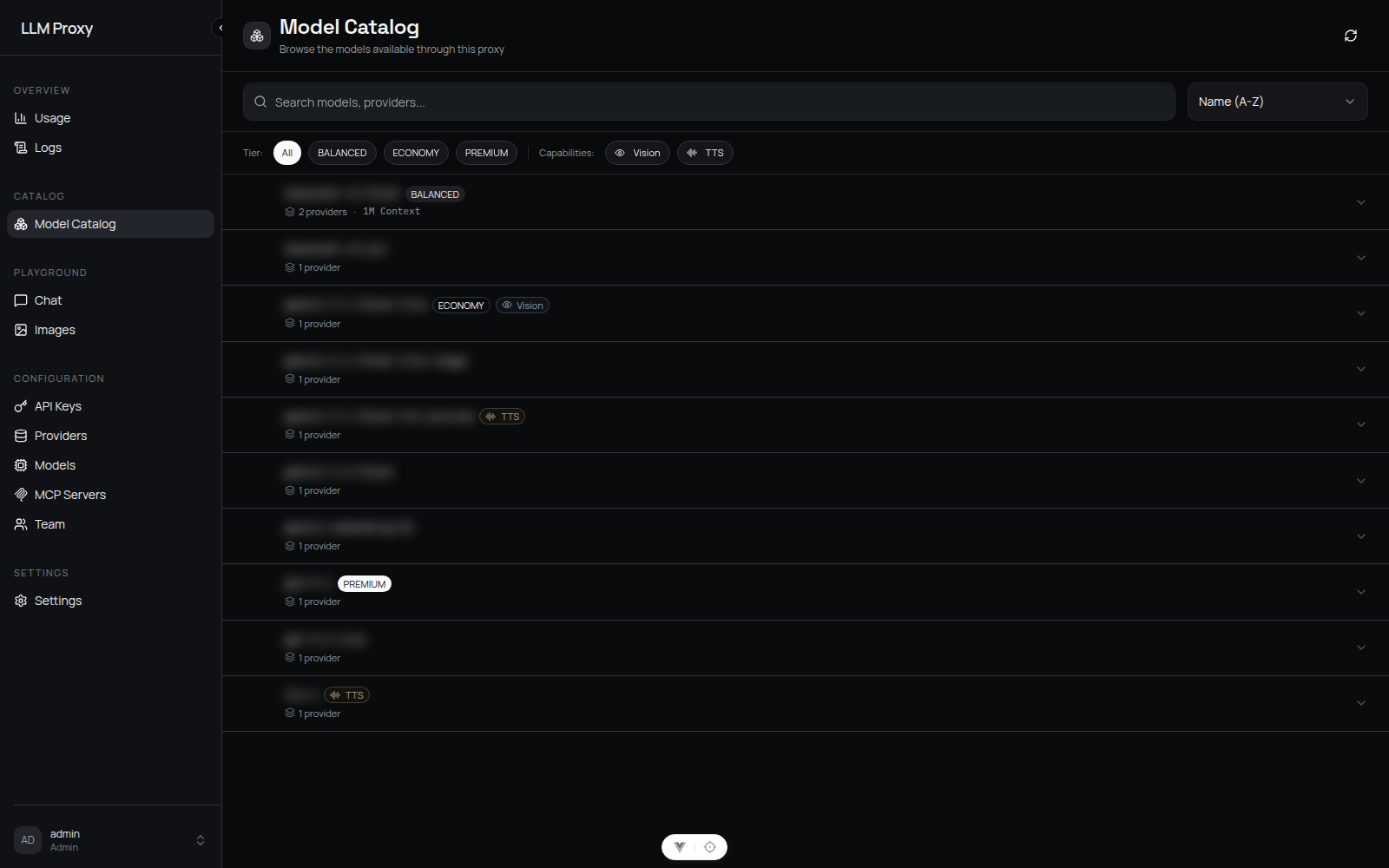
GET /api/catalog/models | Display-oriented catalog for the UI (no pricing); also allowlist-filtered |
| Models screen (admin) | Full management view |
| Models screen (viewer) | Read-only catalog of what that account may use |
Related
- Providers — the upstreams these models point at
- Virtual Models & Routing —
auto/fast/best - Cost Control — prices → budgets → enforcement